
PUPA Focusing Certification Program.
1 and 2 year programs to become certified in Focusing
The International Focusing Institute is currently working to offer a new certification offering. Details coming very soon. If you’re interested in a one or two year program, please email me!

Become certified by The International Focusing Institute.
Option to attend the Advanced and Certification Weeklong at the end of your program.


The PUPA Focusing Certification program is created and led by Coordinator Annette Dubreuil.
“I highly recommend the courses offered by Annette. Her manner is clear and professional with a great depth of understanding and compassion. I took the entire journey through to the certification process with her and it has been an enlightening and expanding experience.”
Core courses of the PUPA Focusing Certification Programs

In this eight-week course, we slowly get to know each of the 6 steps of Eugene Gendlin’s Focusing practice.
Each week, we learn about one or two steps and/or a new way of listening in Focusing partnerships. Here is the course overview by week:
Clearing a space and the Focusing attitude (receiving) + Holding space
Finding a felt sense + Saying back (mirroring)
Finding a felt sense about an issue + Felt Sense Polyvagal Model (continue mirroring)
Getting a handle and resonating + Reflecting with our own words (active listening)
Felt shifts + continue active listening
Asking + Helping your Focuser with general prompt questions (experiential peer listening)
Asking + Helping your Focuser deepen their experience with specific questions (experiential peer listening continued)
Noticing patterns + Helping your Focuser deepen their experience with specific questions (experiential peer listening continued)
As we go, we gradually grow our Focusing and listening skills, by building each week some of these skills.
You’ll learn to know where the Focuser is in the process, and when to ask questions which help the process move along, such as:
“Where do you carry that in your body?”
“Can you get a handle for that?”
“What’s the worst about that?”
“What would it feel like if it was all better?”
Each class begins with a centering/grounding practice and a check-in. We then have a a teaching piece of a Focusing step or two and/or some listening skills and a small embodied guided exercise (experiential). We’ll then have a short break and come back for a demonstration followed by breakout room practice (groups of two or three). We end back together in the main room for some Q&A, sharing and a brief closing.
To further your practice, it is encouraged to also form a Focusing partnership with another participant. This involves meeting between classes to practice, in an exchange of Focusing and listening. You can also opt to be assessed for the Proficiency in Focusing Partnership Award provided through TIFI in the final few weeks of the course.
Timing and other details
Next Groups—Dates, Times and Course Teachers (see more on teachers below):
Wednesdays, May 6-June 24, 9:30-11:30 am Eastern (see your local time) with PUPA Focusing Founder and Coordinator Annette Dubreuil and co-taught by PUPA Focusing Trainee Anne-Marie Jourdenais
Upcoming classes - dates to be determined. Please email me at annette@pupa.ca if you cannot make the above course to let me know when you would be available for this training. If you have previous listening experience or are someone who is an intermediate or experienced Focuser, you could also look at the 4-week version of this course.
Group size: each group has between 12-24 participants.
Who is this course for? The course is designed for beginners (both beginners in Focusing and listening). (There is also an intensive 4-week version of this course which may be better suited to you if you are an experienced listener but a beginner Focuser).
Course location: Zoom
Sliding scale pricing: This course has sliding scale pricing, offering multiple price points to make the course more accessible and reduce financial barriers for people with different levels of income. Please view the sliding scale fees page for details and codes.
Full fee: US$320
25% off: US$240
50% off: US$160
70% off: US$96
80% off: US$64
90% off: US$32
Notes:
This course is to learn Focusing in partnership. Breakout room practice and practice in between classes help build that muscle. As such, live attendance is essential. That said, we recognize that sometimes an absence is inevitable. Therefore the classes are recorded and shared with you. This includes the guided exercises, slide teachings, demonstrations and group sharing. Breakout room practice is not recorded.
You can take this class as a stand alone experience, continue on with the whole PUPA journey, or whatever course or courses resonate with you.
Consisting of five courses, the journey covers learning Focusing (this course), learning about who you are, discovering who you want to be and what you want to bring into the world with Thinking At the Edge (TAE, Gendlin’s second practice), transforming a large block using the 8Cs of self-leadership, and finally a course on taking action with embodied leadership.
The journey can be extended to the PUPA Focusing Certification Program, which includes additional requirements to become a Certified Focusing Professional with The International Focusing Institute.

Our process groups are an opportunity to meet in a group (see options below) to allow the process of Focusing to carry you forward, while deepening both your Focusing and listening skills. There is a strong emphasis on building self-compassion through common humanity in these groups, via empathic reflections and empathy circles.
An empathy circle, practiced in a Focusing way, is at first a regular Focusing exchange, however it is held by the entire group. As such, there is a Focuser, a listener, and the remaining participants act as space holders (observers, witnesses). After the Focusing, all are invited to pause and sense what is happening in them now. An empathic reflection can then be offered by all who choose. The empathic reflection can be what was//is now felt physically (felt sense), or the word, phrase or image (handle) that came//now comes to mind. After all who wish to share have shared, the Focuser can then say what more comes in hearing the empathic reflections. In essence, it is a Focusing demonstration that all observers are welcomed to experience and help further unfold with their reflections.
Empathy circles are powerful, as many kind-hearted people holding space allows for deep healing work!
Our PUPA Focusing Process Groups groups use the following format:
each week we will begin with a brief centering and check-in
next, one participant will be the empathy circle Focuser of the week, having a 15-minute experience. The listener can be the course teacher or another participant. The rest of the group holds space, and then at the end, has the option to pause and then offer their empathic reflections.
participants have a choices for how they’d like to practice during the one hour of breakout room time. Options include:
breakout room practice in groups of two or three, which allow more time per person.
round-robin practice, where participants are in a larger group, four or five, and go around the “circle”, taking turns Focusing and listening. This is a powerful option when participants connected deeply to the empathy circle topic we just had, and wish to stay with that, to explore what came up for them and how they were personally touched (this is inspired by the Interactive Response in Interactive Focusing). Option to offer empathic reflections after each Focusing round.
stay in the main room for a generative Focusing conversation, that emerges from the empathy circle.
a brief sharing, followed by discussion of any questions
finally, we will have a closing
During the breakout room time, the course teacher and any co-teachers/assistants will be available to co-listen. This is where you have the option to have us come into your breakout room to provide coaching on your listening.
The group will not teach any pre-planned content other than the empathy circles and empathic reflections, which are inspired by Interactive Focusing. However, concepts or teaching aids will be shared as needed and arise naturally from the group.
To further your learning and practice, it is encouraged to also form a Focusing partnership with two other participants. These groups of three involves meeting between classes to practice, in an exchange of Focusing and listening, with the third person keeping time, and providing a stronger container for deep work. It is also an opportunity to share observations. You can also opt for a traditional dyad partnership.
Group Options
We currently offer four kinds of Focusing Process Groups. All of our groups meet for two hours per week,
A regular group, of up to 24 participants, which meets for four weeks.
A small group, of up to 6 participants, which meets for six weeks.
A topic-specific group, of up to 16 participants, which meets for six weeks.
A Focusing facilitator certification group, that meets for 12 weeks (this group overlaps with three regular groups, and has an additional 30 minutes each week just for those doing the certification training)
this group meets for longer, as it has a requirement of doing 15 hours of client sessions or some other incorporation of Focusing into your private or professional work; the extra time is to support students and answer questions that arise from this work.
Timing and other details
Next Groups and Teachers:
Regular Groups (4-weeks each) led by Coordinator Annette Dubreuil.
Mondays, March 30-April 20, 2026, from 12:30-2:30 pm Eastern
Mondays, April 27-May 25 (break week May 18), 2026, from 12:30-2:30 pm Eastern
Note: you can sign up for more than one of the groups above if you so choose. Those doing the Facilitator training (see below) will do all twelve weeks, so there will be some continuity.
Focusing Facilitator Certification Group led by Coordinator Annette Dubreuil.
Mondays, March 2-May 25 (12 weeks), 2026, from 12:30-3:00 pm Eastern (three 4-week regular groups, with an additional 30 minutes afterwards).
World of Crises: space to explore the various crises in the world right now, e.g. wars, inequality, climate change, led by Coordinator Annette Dubreuil and PUPA Trainee Niamh Harnett.
This topic-specific group will meet for six weeks on Tuesdays, May 5 to June 9, from 9:30-11:30 am Eastern.
TBD - please email me at annette@pupa.ca if you are interested in a group and cannot make the above times/dates
Who are these groups for? The Focusing Process Groups are designed for Focusers of all levels. However, some previous Focusing training is required (the steps will not be taught and some listening experience is required). This experience can be gained through the 8-week beginner course or the 4-week intensive beginner course.
Course location: Zoom
Sliding scale pricing: These groups have sliding scale pricing, offering multiple price points to make the groups more accessible and reduce financial barriers for people with different levels of income. Please view the sliding scale fees page for details and codes.

This course is an opportunity to get to know your hurt and protective parts while strengthening access to your grounded Self. We learn how each of these experiences connect to your nervous system, and ultimately tell your story with a timeline or other visual mapping.
Owning your story is the bravest thing you will ever do.
—Brené Brown
Understanding who we are in an embodied way is a powerful way to grow our emotional regulation and emotional intelligence. When we know what it feels like in our bodies when we get scared, or mad, or are happy—or when more complicated patterns or parts emerge—then we can more quickly notice these shifts in our autonomic nervous system.
In addition, growing our access to our grounded and calm self with Focusing practice, ensures that we can more easily access that part of us when something does happen. This clarity helps us know when we need to self-soothe or reach out to others for co-regulation.
If one does not have the felt meaning called “understanding the context,” one will only grasp a very limited, superficial part of a symbolization.
—Eugene Gendlin, Experiencing and the Creation of Meaning, page 128
In this course, we use Focusing to explore our autonomic nervous system, getting to know the three main kinds of experiences we can have in our nervous system. We do so using Jan Winhall’s Felt Sense Polyvagal Model™ as a model for the nervous system and Internal Family Systems as the roles the parts play:
grounded (flock, fun, flowing)
hurt (wounding interaction that takes us from flock/fun/flow to fight/flight/fold/fixate/freeze/fawn)
protective (fight/flight, fold, fixate/freeze/fawn)
Using Focusing, we get to know a few parts of ourselves each class and steadily build a new story of our life to date. We notice when parts emerged. How old were we? What happened to spur it to life? How did it help? And does it hurt now?
The class spends the first three weeks connecting to our grounded Self, building a “safe nest” to do the deeper Focusing on our wounded and protector parts in weeks four to seven. As we map our experiences with felt sense body cards, we learn about our nervous system and our history. We finish the class by retelling our stories. Some students do this by creating a timeline and noticing what additional insights emerge for them in being with the timeline. Some participants find it more helpful to tell their story another way: mapping something else, such as their autonomic nervous system, or creating an art project or writing a poem.
Insight involves our ability to shape and tell our story in a way that is both coherent and that maintains emotional contact with its meaning. We are neither overwhelmed by, nor disconnected from, what happened to us, and we have a developing sense of meaning about our pathway through life. Only through integration of the limbic-based memory with the capacities of the middle prefrontal region in both hemispheres does this capacity emerge.
—Bonnie Badenoch, 2008
To further your practice, it is encouraged to also form a Focusing partnership with another participant. This involves meeting between classes to practice, in an exchange of Focusing and listening.
Timing and other details
Dates:
Thursdays, May 1-June 26, 2025, break week May 29
Time: 10 am - 12 pm Eastern (New York Time) - see your local timeRegistration deadline is
April 29thextended to today, April 30th
TBD - email Annette at annette@pupa.ca if these dates and times don’t work for you to find out about future offerings of this course.
Course size: each group is between 8 and 24 people
Who is this course for? The course is designed for all levels of Focusers. However, some previous Focusing training is required as you need to be able to access your Felt Sense and hold space (have practice in Focusing partnerships). This beginner training can be learned in Annette’s 4-week or 8-week beginner courses. This course emphasizes getting to know and name in an embodied way the main parts of ourselves.
Course location: Zoom
Sliding scale pricing: This course has sliding scale pricing, offering multiple price points to make the course more accessible and reduce financial barriers for people with different levels of income. Please view the sliding scale fees page for details and codes.
Full fee: US$480
25% off: US$360
50% off: US$240
70% off: US$144
80% off: US$96
90% off: US$48
Notes:
This course is to deepen your Focusing and listening. Breakout room practice and practice in between classes help build those muscles. As such, live attendance is essential. That said, we recognize that sometimes an absence is inevitable. Therefore the classes are recorded and shared with you. This includes the guided exercises, slide teachings, demonstrations and group sharing. Breakout room practice is not recorded.
You can take this class as a stand alone experience, continue on with the whole PUPA journey, or whatever course or courses resonate with you.
Consisting of five courses, the journey covers learning Focusing, learning about who you are (this course), discovering who you want to be and what you want to bring into the world with Thinking At the Edge (TAE, Gendlin’s second practice), transforming a large block using the 8Cs of self-leadership, and finally a course on taking action with embodied leadership.
The journey can be extended to the PUPA Focusing Certification Program, which includes additional requirements to become a Certified Focusing Professional with The International Focusing Institute.

Do you want to understand more about why you’re drawn to Focusing? Do you have a sense Focusing can play a greater role in your life? Do you feel a wanting to bring it into the world through teaching or private sessions? In this 8-week course you will have a safe space, guidance and companionship to discover something about yourself crossed with Focusing. We will give you support to connect with your inner knowing, a kind of certainty you feel in your body but that you are not yet able to express.
The course is an opportunity to spend time with your wanting or project to integrate Focusing into your life—whether personally or professionally—in both an embodied and more than logical way. Like being in contact with a yet undiscovered treasure box. With FOCUSING, a practice laid out by philosopher and psychotherapist Eugene T. Gendlin, you will get in touch with your Felt Sense and be able to develop surprisingly fresh understandings that make a difference, especially in how you are with your special project or issue. By adding certain moves of THINKING AT THE EDGE (TAE), another practice Gendlin created, with Mary Hendricks and Kye Nelson, we will show you how you can speak more and more precisely from your Felt Sense. In doing so, you will discover important details by redefining key terms, becoming aware of paradoxes or clarifying the richness of your lived experience.
You will end with your own concept map of your project ‘Focusing and You.’ This could be your expertise that you want to cross with Focusing. The TAE process will give you a language to speak about your project, in a deeply embodied way while also very precisely. The course will also help you to define concrete action steps that feel right.
The teaching will include basic terms of Gendlin’s philosophy, as well as an overview of the first 12 TAE-steps. We will introduce exercises which you will practice in breakout rooms, using rotating partnerships. Partners will take notes for each other to capture words and ideas, ensuring they are available for the ongoing process. To deepen your practice and allow for further unfolding, it is encouraged to form a partnership with another participant to meet between classes.
As needed, we will use Focusing to unpack how doing TAE is affecting us.
To further your practice, it is encouraged to also form a Focusing partnership with another participant. This involves meeting between classes to practice, in an exchange of Focusing and listening. This course counts towards the requirements for the TAE Proficiency Award provided through TIFI.
Timing and other details
Next groups with Annette Dubreuil:
Thursdays, September 4-October 30, 2025 (break week October 2nd)
Time: 10 am - 12 pm Eastern (New York Time) (see your local time)Registration Deadline September extended to the 3rd1st
TBD - email Annette at annette@pupa.ca if these dates and times don’t work for you to find out about future offerings of this course.
Course location: Zoom
Course size: each group has between 8-24 participants—12 spots left
Who is this group for? The group is designed for all levels of Focusers. Some previous Focusing training is required as you need to be able to access your Felt Sense and hold space (have practice in Focusing partnerships). This beginner training can be learned in Annette’s 4-week or 8-week beginner courses.
This course is ideal for people who can attend all sessions live, as we spend significant time each class practicing. Being able to be present will be most fruitful for your experience.
The course provides one's own experience with the thinking movements of TAE, which is the basis for guiding others.
Language: English (The instructors has fluency in French, and can translate for english as a second language speakers as needed.)
Sliding scale pricing: This course has sliding scale pricing, offering multiple price points to make the course more accessible and reduce financial barriers for people with different levels of income. Please view the sliding scale fees page for details and codes.
Full fee: US$480
25% off: US$360
50% off: US$240
70% off: US$144
80% off: US$96
90% off: US$48
Notes:
This course is to deepen your Focusing and listening, as well as to learn Thinking At the Edge (TAE). Breakout room practice and practice in between classes help build those muscles. As such, live attendance is essential. That said, we recognize that sometimes an absence is inevitable. Therefore the classes are recorded and shared with you. This includes the guided exercises, slide teachings, demonstrations and group sharing. Breakout room practice is not recorded.
You can take this class as a stand alone experience, continue on with the whole PUPA journey, or whatever course or courses resonate with you.
Consisting of five courses, the journey covers learning Focusing, learning about who you are, discovering who you want to be and what you want to bring into the world with Thinking At the Edge /TAE, Gendlin’s second practice (this course), transforming a large block using the 8Cs of self-leadership, and finally a course on taking action with embodied leadership.
The journey can be extended to the PUPA Focusing Certification Program, which includes additional requirements to become a Certified Focusing Professional with The International Focusing Institute.

In this 8-week group, you will use Focusing to transform a significant issue in your life, in part by deepening your access to Self through the 8Cs of Self-Leadership (a concept from Internal Family Systems by Richard Schwartz). This can be working towards a personal or professional goal (could be your special project developed in the Thinking At the Edge course). However, the course is designed in such a way that you can also bring a different topic each week to your Focusing, and concentrate on building your 8Cs which help you live as your Self more often.
Transform yourself to transform your life and the world
"Few of us can actually change the world. We can only change ourselves. But if enough people took that to heart, the world would change.” ― Tammara Webber,Good For You
Curriculum
In this course, you will get to know your 8 Cs of self-leadership, that will catalyze your transformation. We do this through the PUPA process, which combines Focusing with Theory U—going through each of the Cs in a resourcing order. In so doing we naturally shift over the course of our eight weeks from a caterpillar to a butterfly. We build a safe space to transform (called a pupa, this space is a chrysalis in a butterfly and a cocoon in a moth), using parts of ourself and our Focusing partner as resources.
By crossing a C resource into our Focusing each week, we use embodied positive psychology to help ourselves grow. The group will cycle through the PUPA process as follows:
Pause:
calmness (getting grounded, clearing a space, and choosing a project for the course)
connectedness (developing the Focusing attitude, and seeing the project/issue through fresh eyes)
Understand
curiosity (getting to know the crux of our topic, as it unfolds. Learning what most needs attention)
clarity (getting to know the threads or parts involved)
Permutation: physical felt shift + paradigm shift
creativity (the desired future Self (or way) begins to emerge)
Prepare
compassion (dealing with the critic, the part that says you can’t do this)
confidence (seeing ourselves taking the action, visualizing)
Act
courage (being our transformed selves, with grit)
“If you want to change the world, start with yourself.”—Mahatma Gandhi
How the Group Works
Each class consists of four parts: centering, teaching, experiencing and group practice. The centering piece grounds us by connecting to a memory of our “C” of Self-Leadership that week. The teaching piece covers some content for our C of the week, and is aided with PPT slides. The experiential piece is a guided Focusing experience, where we get a felt sense of where we are with our issue, and then bring in our 8C or 8Cs into our Focusing of the issue as it is now.
The teaching crosses in many complementary tools, including the latest neurobiology research, grounding in the body, Jan Winhall's Felt Sense/Polyvagal Model, getting to know the "parts" of ourselves, emotional intelligence, drawing/art, and journaling/free-flow writing.
The group practice at the end of each class is where participants practice Focusing with each other. We do this either as a large group, or in small groups in breakout rooms (groups of two (dyads) or triads). Some weeks we practice empathic listening, which brings a special deep knowing and sharing to our fellow participants.
To further your practice, it is encouraged to also form a Focusing partnership with another participant. This involves meeting between classes to practice, in an exchange of Focusing and listening.
“Yesterday I was clever, so I wanted to change the world. Today I am wise, so I am changing myself.”― Rumi
Timing and other details
The Group Meets:
Thursdays, 10 am to 12 pm Eastern, November 20, 2025-January 22, 2026 (break weeks December 25, 2025 and January 1, 2026)
Registration deadline extended to November
17th19th
TBD - email Annette at annette@pupa.ca if these dates and times don’t work for you, to let me know your availability and to find out about future offerings of this course.
Course size: each group has between 8-24 participants.
Who is this course for? The course is for Focusers who are wanting to transform a significant issue in their life. It is designed for all intermediate/experienced Focusers. The course emphasizes getting to know and name in an embodied way your 8Cs of Self-Leadership, and crossing these resources into the Focusing of your issue, as it is carried forward week by week. Therefore, previous experience with crossing, for example from our TAE course, is helpful. If you are a beginner Focuser and looking for a course to transform something, this process skipping course might be for you.
Course location: Zoom
Sliding scale pricing: This course has sliding scale pricing, offering multiple price points to make the course more accessible and reduce financial barriers for people with different levels of income. Please view the sliding scale fees page for details and codes.
Full fee: US$480
25% off: US$360
50% off: US$240
70% off: US$144
80% off: US$96
90% off: US$48
What People Are Saying
“The 8cs course was a revealing enlightening experience. Each week focusing on one theme in the course, I was able to experience the essence of the theme for that week...even as a fairly new person to Focusing, Annette gently creates and opens the space for each participant to immerse into the theme for each week. Annette has a teaching quality that enables each participant to create and build their awareness and experience of each of the 8Cs. A truly gifted teacher, who puts everyone at ease, holding a space for magic to happen in each persons experience. Thank you Annette. Kindly, suzy”
— SUZY, UK
“Keeping with one issue and continuing to revisit it each week is a whole new experience for me. A much needed step in my processing. Getting to know my 8Cs has been such a resource for me. For example, I reviewed my 8Cs body cards yesterday when my energy was wonky and it was SO helpful to have the visuals!!!!! I was so happy to see how easily my state was able to shift. I just feel my time with Annette has aided me in coming out of a deep stuck funk I had been in. I'm aware of so much energy, awareness and insights now (and what autonomic nervous system state I'm in at any given time—appreciate learning to track that!). My system REALLY needed to be listened to....and this course was just so perfect for me!!!! Getting information directly from the body via Focusing has been far superior to other modalities I've done in the past. I felt the work was much deeper. Annette is a great facilitator and I appreciate all the research she's put into blending modalities and coming up with a cohesive program with the PUPA process.”
— SHARON, US
“I met Annette when I signed up for her course 8C’s of Self-Leadership (for more detail see Courses above). This turned out to be a unique and memorable experiential course in self-growth. As someone who uses Focusing in my work and in daily life, this course opened up for me new avenues. It was refreshing and invigorating because this course teaches you to allow your uniquely represented C’s to come out and play. Annette developed body cards to map out and symbolize our experience of the different C’s. This was quite a revelation because one can use these body cards as steps of our living process that is in constant flow. The body cards can be a reminder of where we started and allow us to see where we got to by bringing a Focusing attitude of receptivity, openness and non-judgement whilst exploring these themes. Totally recommend this course and feel this would be incredibly beneficial add-on to a variety of training environments.”
— VERONICA TOESCU, Focuser practitioner and Focusing-Oriented Therapist, Birmingham, UK
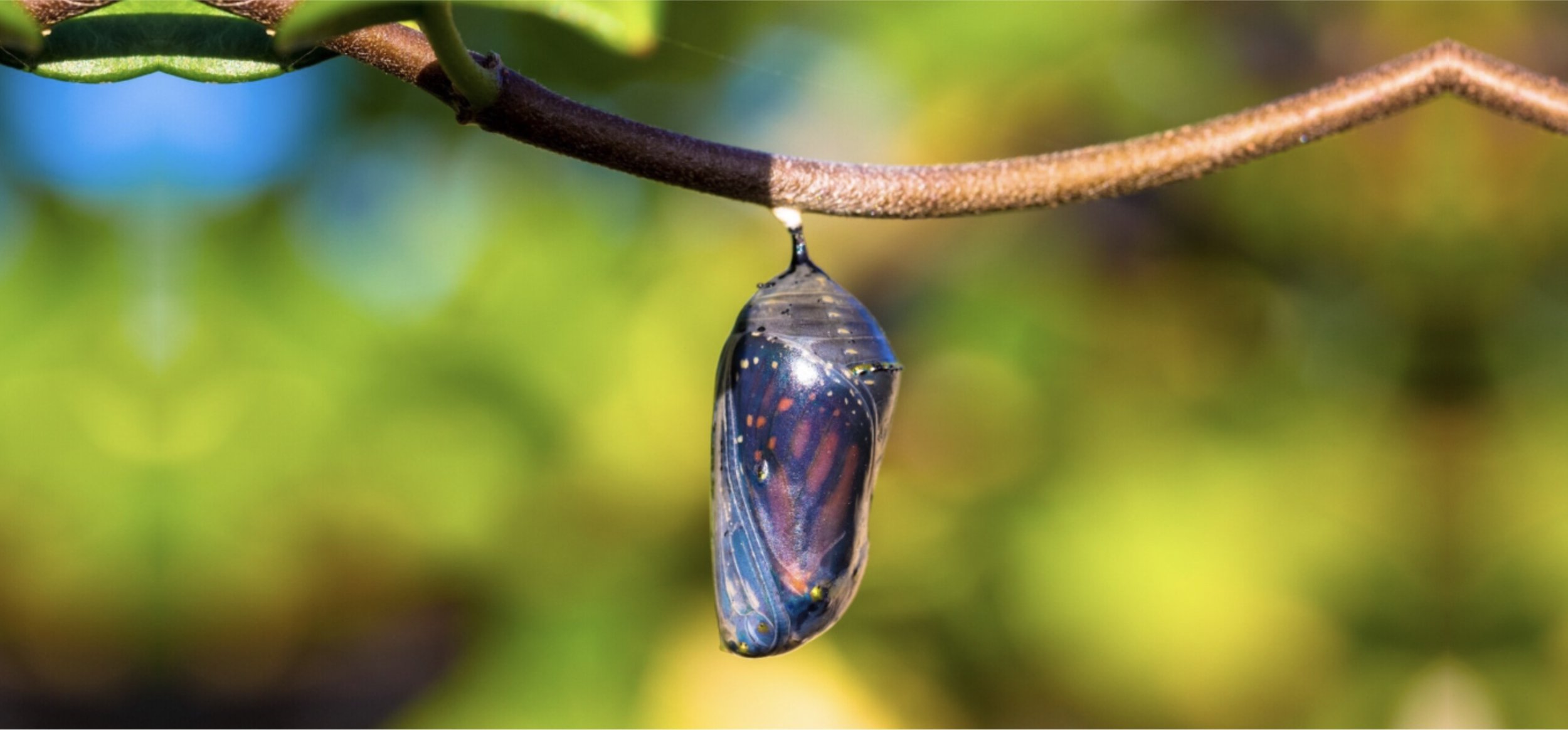
Moving from avoiding with our bad habits, to processing and living
This eight-week course creates a container to unpack a big issue in your life. Using Focusing, you’ll shift a bad habit or addiction that keeps you away from something you long to be or do. And in so doing, tell your untold story.
Process skipping is doing something to keep us from feeling something. The term process skipping has been taken up by the Focusing community to label what we do when we don’t welcome something with Focusing. For example, the BioSpiritual Focusing teachings of Fathers Peter Campbell and Ed McMahon.
This course expands on the works of Gendlin, Campbell, and McMahon, to present a new model of process skipping. This model crosses in other models, such as the absencing cycle in Theory U, as well as insights from Polyvagal Theory, and models of habits and addictions, including Doug Silsbee and Jan Winhall. The new LARVA process skipping model complements my PUP2A model of Focusing and change.
The course uses the LARVA process skipping model as a framework to unpack one thing that is getting in the way of living a more authentic life. This could be a bad habit or an addiction. Some way of acting out that while helpful in the short term, is causing us harm in the long term. As Winhall says, in the case of addictions one “can’t stop doing it” or for bad habits, it might just be really hard.
The course uses Focusing each week as we unpack something you process skip and then find a new way of living our life forward. In short, the two models are:
LARVA Process Skipping Model:
Leverage: something happens that reminds us of our past
Activation: our autonomic nervous system reacts
Rejection: something in us doesn’t want to feel that way
Vindication: we justify doing something to stop the feeling, OR find a reason why we should feel that way
Acting out: we take the substance or do the behaviour that results in some relief
PUP2A Processing Model (Focusing/Experiencing):
Pause: we pause, to prepare for Focusing on the deeper point of our issue
Understanding: our felt sense shares with us the memory (or memories) that needs attention
Permutation: the felt shift with a paradigm shift… a new carrying forward way starts to emerge
Practice: sensing into how we can grow that new way of responding and living
Action: finding our just right next step for how we can be this way now
The course is ten weeks long, and we do one LARVA and one PUP2A. We do the LARVA in reverse order (Acting out, Vindication, Rejection, Activation, Leverage), as we are often consciously aware of our acting out, and less so of some of the intermediate phases or even the initial event that leveraged the rest of the process skipping. So, the acting out is a place to start.
Each week we use Focusing to be with our experience, to listen to our felt sense knowing of what happens in us and give it space to be seen and heard. To really get to know how our process skipping works.
The final five weeks, we use Focusing to be with what our system was trying to avoid with the process skipping. Often the leveraged event is connected to other events, memories from earlier times in our lives. By going back to those memories, we get to process what was needed. To hear our untold story. And then as we round the course out, we find new ways of being in the world, ones that no longer hurts us.
The group will use the following format:
each week we will begin with a centering and check-in
next, we will learn about that week’s LARVA or PUP2A component
we will then have a guided experience to be with that material with Focusing
followed by a demonstration, which will include possible prompts for further processing in breakout rooms
we will then have some breakout room practice. There will be multiple options each week, including groups of two for traditional exchanges, groups of three or four for round-robin practice or Empathy Circles (for those who have done the course Deepening your Focusing and Listening with Empathy and Compassion), or even the option for a second demonstration.
We will also have some PUPA Focusing Trainees co-teaching the course. When not leading an empathy circle or second demonstration, you’ll have the option to have us come to your breakout room to provide co-listening (coaching on your listening).
finally, we will have a closing and final sharing
To further your practice, it is encouraged to also form a Focusing partnership with another participant. This involves meeting between classes to practice, in an exchange of Focusing and listening. You can also opt to be assessed for the Proficiency in Focusing Partnership Award provided through TIFI.
Timing and other details
Teachers: This group will be led by Coordinator Annette Dubreuil and PUPA Trainees Anne-Marie Jourdenais.
Next Groups:
Mondays, November 17 to February 2, 1:30-3:30 pm Eastern (break weeks December 22 and 29, 2025)
TBD – please email me at annette@pupa.ca if you are interested in this course and cannot make the above times/dates
Group size: each group is capped at 24 people.
Who is this course for? The course is designed for Focusers of all levels. However, some previous Focusing training is required (the steps will not be taught and some listening experience is required). This experience can be gained through the 8-week beginner course or the 4-week intensive beginner course.
Course location: Zoom
Sliding scale pricing: This course has sliding scale pricing, offering multiple price points to make the course more accessible and reduce financial barriers for people with different levels of income. Please view the sliding scale fees page for details and codes.
Full fee: US$400
25% off: US$300
50% off: US$200
70% off: US$120
80% off: US$80
90% off: US$40

In this ten-week Focusing course, we learn to use self-regulation and co-regulation to affect the interactions in our relationships. You can explore any relationships, including those that include power (leaders and employees, teachers and students, parents and children). The goal is to use emotional regulation to create safe and connected relationships that allow for creativity and action to flow.
Psychological safe spaces are the most creative and innovative
An embodied leader is self-aware, informed by their body’s wisdom, and able to show up in ways that reflect their values and commitments, even under pressure. They also create spaces that foster creativity and action that is in flow. They do this by having high levels of emotional intelligence; being able to:
be self-aware and self-regulate
be aware of others and co-regulate
In this course, we spend ten weeks developing our embodied leadership skills, primarily using Focusing, with some emotional intelligence and learnings from psychological safety to structure our process.
We do so by taking two five-week PUPA process journeys: pause, understand, permutation, prepare, action. The PUPA process includes concepts from Otto Scharmer’s Theory U (from MIT) and Arawana Hayashi’s Social Presencing Theatre, positive psychology, the 8Cs of Self-Leadership (from Internal Family Systems) and doable action steps. Finally, our learning includes Timothy Clark’s 4 stages of psychological safety.
In our first 5 week journey, we become self-aware and unpack where we create a lack of safety in our relationships: where we armour up by becoming defensive. And then we envision how we’d like to be as an embodied leader who can self-regulate in a calm, grounded and courageous manner, and spend a few weeks embodying that person.
In our second journey, we dig into what our relationships needs from us to have psychological safety and learn to better co-regulate others (students, family members, friends, colleagues, team members, children, etc.) by showing up as embodied leaders and changing our interactions.
We learn to build psychological safety as embodied leaders by learning to create:
inclusion safety (noticing where we experience privilege and power or create oppression)
learner safety (destigmatizing failure)
contributor safety (inviting meaningful participation and inquiry by asking good questions and learning to deeply listen to what is emerging now, even when in a group)
challenger safety (finding the courage to create the world we want)
Format:
This group meets weekly, and our classes have four parts:
centering exercise (e.g. breathwork, clearing a space)
brief presentation of some material to guide our session
either a guided Focusing experience that moves us forward on that week’s leg of our journey, or a demonstration of the prompt questions, that are used in breakout rooms
breakout room practice (sometimes in groups of two, but most often in groups of three that are your Focusing partnership parters, for more intimacy for the deep work we do in this course, and occasionally in groups of four for empathy circles and embodied Masterminding, or larger groups for a generative Focusing conversation)
To further your learning and practice, it is encouraged to also form a Focusing partnership with two other participants. These groups of three involves meeting between classes to practice, in an exchange of Focusing and listening, with the third person keeping time, and providing a stronger container for deep work. It is also an opportunity to share observations.
Timing and other details
Course Dates and Times:
Thursdays, February 12 to April 23, 2026 (break week March 19)
10 am to 12 pm Eastern (see your local time)Registration deadline is February 9th
TBD - email Annette at annette@pupa.ca if these dates and times don’t work for you, to let me know your availability and to find out about future offerings of this course.
Course size: each group has between 8-24 participants.
Who is this course for? The course is designed for intermediate/experienced Focusers. It is if for individuals who would like to use Focusing to improve their leadership skills in an embodied way. It is also for people who would like to improve their relationships, by looking at themselves as a catalyst for change, by improving the co-regulation of their relationships. Whether you’re in a position of power (leader), or a participant (e.g. a team member), you can learn to lead in an embodied way. And this will unleash creative action flow in your relationships. If you are a beginner Focuser and looking for a course to transform something, this process skipping coursemight be for you.
Course location: Zoom
Sliding scale pricing: This course has sliding scale pricing, offering multiple price points to make the course more accessible and reduce financial barriers for people with different levels of income. Please view the sliding scale fees page for details and codes.
Full fee: US$600
25% off: US$450
50% off: US$300
70% off: US$180
80% off: US$120
90% off: US$60

This eight-week course is an opportunity to strengthen your listening skills and deepen your Focusing experiences. In improving your listening skills with empathy and compassion, you create an even stronger container for the felt sense and Focusing process, the motor of change.
Three types of empathy will be explored: cognitive empathy, emotional empathy and compassionate empathy. These will allow you to better understand what might be happening for the Focuser and gradually learn to use your own felt sense while you listen (empathy). The result is more attuned listening reflections and prompt suggestions (compassion).
You will also learn to better sense your own needs while Focusing, in listening to the nuances from your felt sense (self-empathy) and then meet those needs, either by giving that to yourself or asking your listener for what it needs (self-compassion and Storyteller-as-Teacher).
To build these empathic listening skills, we’ll use specific exercises that occur after Focusing, including the double empathic moment and interactive response from Interactive Focusing by Janet Klein and Mary McGuire, and broader empathic responses, like those used in our Empathy Circles (see notes below).
Our learning of empathic listening for Focusing, uses inspiration from a number of people, including: Eugene Gendlin, Carl Rogers, Interactive Focusing (Janet Klein, Mary McGuire, and Masumi Maeda), Tomeu Barceló, Glen Fleisch, Allan Rohlfs, as well as a host of empathy researchers.
We will also explore ways to use your empathy relationally during a Focusing session, and when to share that with the Focuser. Sharing in a relating way and empathic reflections are especially helpful for building self-compassion through common humanity. Finally, we’ll cover what to do if we relate too much and go into empathic distress.
The group will use the following format:
each week we will begin with a centering and check-in
next, we will learn about that week’s particular kind of empathy and its listening implications (there are eight in total, which can be mapped to the three types)
we will then have a 15-20 minute demonstration each week. During the few weeks that we do Empathy Circle responses, the other students will be able to offer their empathic reflections.
we will then have at least an hour for breakout room practice. There will be multiple options each week, including groups of two for traditional exchanges, groups of three or four for round-robin practice or Empathy Circles (see notes below), or even the option for a second demonstration.
We will also have some PUPA Focusing Trainees co-teaching the course. When not leading an empathy circle or second demonstration, you’ll have the option to have us come to your breakout room to provide co-listening (coaching on your listening).
finally, we will have a closing and final sharing
To further your practice, it is encouraged to also form a Focusing partnership with another participant. This involves meeting between classes to practice, in an exchange of Focusing and listening. You can also opt to be assessed for the Proficiency in Focusing Partnership Award provided through TIFI.
Timing and other details
Next Groups:
Tuesdays, April 21-June 9, 7-9 pm Eastern/Wednesdays, April 22-June 10th, 9-11 am AEST (see your local time here) with PUPA Focusing Trainer Marg Peck
Registration deadline is April 18th extended, you can still register!
TBD - please email me at annette@pupa.ca if you are interested in this course and cannot make the above times/dates
Group size: each group is capped at 24 people.
Who is this course for? The course is designed for Focusers of all levels. However, some previous Focusing training is required (the steps will not be taught and some listening experience is required). This experience can be gained through the 8-week beginner course or the 4-week intensive beginner course.
Course location: Zoom
Sliding scale pricing: This course has sliding scale pricing, offering multiple price points to make the course more accessible and reduce financial barriers for people with different levels of income. Please view the sliding scale fees page for details and codes.
Full fee: US$320
25% off: US$240
50% off: US$160
70% off: US$96
80% off: US$64
90% off: US$32