
Felt sense body cards

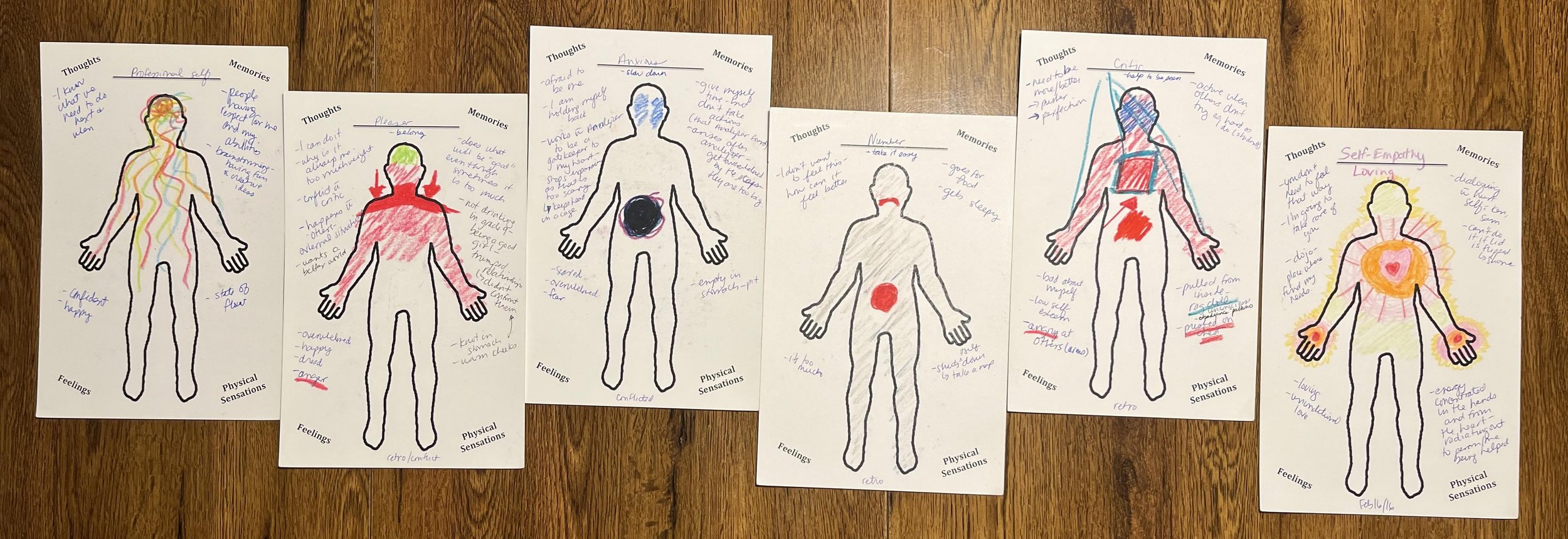
Felt Sense Body Cards of the 8Cs qualities of Self-Leadership
I came up with the idea for the felt sense body cards in the spring of 2015 at a Focusing on Borden Trainers meeting. We were planning a course on ego states and I had seen recent research on bodily maps of emotions.
If we could illustrate emotions in the body, then we could the felt sense, which is more intricate!
We are all made up of a number of different personality parts which each have their own unique felt senses. Felt senses plural, as each time a felt sense forms, it forms freshly. So, it won’t be exactly the same each time. But there are patterns that emerge!
In this blog, I cover the parts and qualities of our selves we can map with the felt sense body cards. I’ve found this work to be the best use of the cards. However, they are also quite useful for recording what comes in any Focusing session.
Ego States
These different parts are called ego states because whichever state we are in, we think of it as a part of ‘me’ (see Federn, Weiss and Watkins to learn more about ego states/ego state therapy). Typical ego states include the critic, the hurt child and the grounded self, but one can identify dozens of states and each will be unique to us.
Ego states are formed “to enhance the individual’s ability to adapt and cope with a specific problem or situation” (Watkins & Watkins, 1997). They create a physical neural pathway in the brain that has its own emotions, abilities, and experience of living (in other words a felt sense). We switch into an ego state when the need for it occurs, including when we are reminded of a past injury (an injured part of us is triggered). If multiple states are active at once, we can feel conflicted.
Identifying the felt sense of each ego state facilitates identifying which are currently active. We can then tease out the patterns between the active ego states, learning how they interact and dialogue together. This helps identifying the edge we are working on.
Using Focusing and the Focusing attitude, we can resolve or carry forward stopped processes that led to an ego state’s formation, enabling it to become constructive, reframed and integrated.
Ultimately this work of getting to know and resolve our ego states can result in the ability to call on specific ego states for the purposes they serve, including by invoking its handle (Winhall, 2014). We do this knowing that they can now interact well with our other ego states internally, due to our “inner community integration” (Badenoch, 2008), and with other people, externally.
Connecting our parts to different mapping systems

Jan Winhall’s Felt Sense Polyvagal Model™
The felt sense body cards are a powerful way to record the various parts of our personality, and we can then map these onto various systems. I like to use two system: Jan Winhall’s Felt Sense Polyvagal Model™ (FSPM) for the autonomic nervous system (see figure showing 6Fs client version) and Internal Family Systems (IFS) by Richard Schwartz for the psychological system.
In most cases, we will have many parts or qualities for a given sub-section of a mapping system or model. For example, we all have many qualities that can be mapped onto flock in the FSPM. In the IFS nomenclature, there are eight grounded qualities, called the 8Cs of Self-Leadership: compassion, clarity, calmness, confidence, curiosity, courage, connectedness, creativity (see felt sense body card examples of the 8Cs above).
Similarly, we can have multiple parts for the other FSPM states: fight/flight, fold/collapse, fixate/freeze, fun/fired-up and flowing. These states can play specific roles. In IFS language, we tend to find wounded or exile parts in fight/flight, while protective parts or managers can be there too like the critic or anxiety, or be in shutdown fold such as with numbing or depression. Finally, firefighters live in fixate and their actions shift the body from a state of fight/flight to fold or vice versa. However, the way parts map vary person to person.
Ruther Culver has a great graphic that combines IFS and polyvagal theory in the Survive/Thrive Spiral that gives many examples of the kind of protector parts we can have.
Seeing more

Protective Pleaser Part
Recording our felt senses on felt sense body cards allows us to see more than what we already knew. As such, using the cards are an exercise in art therapy that facilitate felt shifts (Rappaport, 2009). For example, in mapping a pleasing part of me that volunteered my way into connections, I saw that the process also made me small (see image of extra big raised hand).
When we lay out our cards, we can also get a felt sense that some parts are missing, and then use Focusing to identify and record the missing parts. And as we use the cards in future Focusing sessions, or even discussions, patterns and insights can emerge from the multiplicity (the more) of the whole collection (Gendlin, 1991).
We can also see our development as we look at our cards in chronological order, as more flock, fun and flow parts emerge and are mapped. This can happen as a zig-zag (Gendlin, 2004) process, the more we heal and work with our trauma, the more we create room for growth and more grounded parts to carry forward.
Bonnie Badenoch (2008) expresses why recording and mapping our story helps one integrate. “Insight involves our ability to shape and tell our story in a way that is both coherent and that maintains emotional contact with its meaning. We are neither overwhelmed by, nor disconnected from, what happened to us, and we have a developing sense of meaning about our pathway through life. Only through integration of the limbic-based memory with the capacities of the middle prefrontal region in both hemispheres does this capacity emerge.” When have a series of cards, we can use them to tell our story in a timeline.
Two ways to use the felt sense body cards
The felt sense body cards can be used to both record a Focusing session as well as parts or qualities of Self as described above. Here are some more directions on how one can use the cards.
1. Record the felt sense of a particular Focusing session
in words:
the four main aspects of the felt sense: physical sensations, feelings, thoughts and memories (Winhall, 2014) in the four corners.
the main handle of the session, on the line called handle
categorize the card (e.g. using FSPM, IFS, etc.)
the date of the Focusing session
journaling about the experience, on the back of the card, with embodied writing, poetry or other notes
in drawing:
the felt sense in and around the body outline on the card, using coloured pencils, markers, or pens
capturing an image that comes with a Focusing session on the back of the card. These could include an illustration of the handle, a metaphor, a scene where the felt sense is active, or of the memory that the felt sense evoked
2. Record a familiar part of us, often accessed via a memory
This can be a strand or facet of a Focusing session.
Can use the FSPM and/or IFS to classify the part
I like to keep these cards in a separate pile.
Multiple rounds of focusing can be used to flesh out the details of these three ways of perceiving the felt sense (written descriptions, visualization of where it’s carried in the body, illustrating a depicting an image or scene of the handle).
The on-demand workshop below shows more examples of body cards, as well as ways they can be mapped and used to tell your story. It also includes two embodied Focusing exercises.
In this two-hour workshop, you’ll have the opportunity to learn about and use felt sense body cards in your Focusing practice.
Felt sense body cards (body cards for short) are a way of capturing our Focusing experiences—whether a whole session, or we can use multiple body cards to capture sections of a session. This can be how the felt sense was at the beginning, and then how the felt sense was after the felt shift. Or we can capture different parts of our personality with a body card.
The back of the body cards are also used to draw images that come to us in Focusing. The workshop will cover the different ways images, as handles, can carry forward our felt sense.
The workshop will also include some ways we can classify our Focusing experiences using models like Internal Family Systems (Richard Schwartz) or the Felt Sense Polyvagal Model (Jan Winhall).
Finally, the workshop will include two guided Focusing experiences for you to then record with some felt sense body cards, followed by some breakout room practice to further unfold your experiences. The two guided Focusing experiences will be:
to connect to a positive memory, to then capture this resourcing energy.
to be with an issue, and possibly notice the different parts that are involved in the issue (this could including naming them with a handle and classifying them according to one of the frameworks presented, or you can sense into your own).
You will receive the felt sense body cards to record your experience during the workshop, and the slides afterwards.
Workshop Details
Date and Time live workshop was held: Tuesday, November 21st, 2023, 1-3 pm Eastern Time
Ways to participate:
Recording only
Who is this workshop for?
This workshop is for Focusers of all levels who would like to grow their practice. You can choose to do the breakout room exercise on your own or with someone you’ll watch the recording with. Previous Focusing practice in partnership is helpful but not required. Instructions will be provided.
Sliding scale pricing:
This workshop has sliding scale pricing, offering multiple price points to make it more accessible and reduce financial barriers for people with different levels of income. Please view the sliding scale fees page for more details and codes.
Full fee: Recording only $19
25% off: US$14.25
50% off: US$9.50
70% off: US$5.70
80% off: US$3.80
90% off: US$1.90